The examiner's question list.
When a regulator, an auditor, a court or an unhappy customer asks about a decision your AI made or shaped, the questions are predictable. This guide lists forty of them, in the order they tend to arrive, says why each is asked and which rule it comes from, and shows what a good answer looks like and what a weak one sounds like. It ends with a scorecard you can fill in for one real decision this week.
Forty questions, in the order they arrive.
Grouped into eight parts. Each question says why it is asked and which rule it comes from, what a good answer looks like, and what a weak one sounds like. Claims, lending, support, compliance and risk leaders, and the engineers who run the agents. No vendor is needed to act on it.
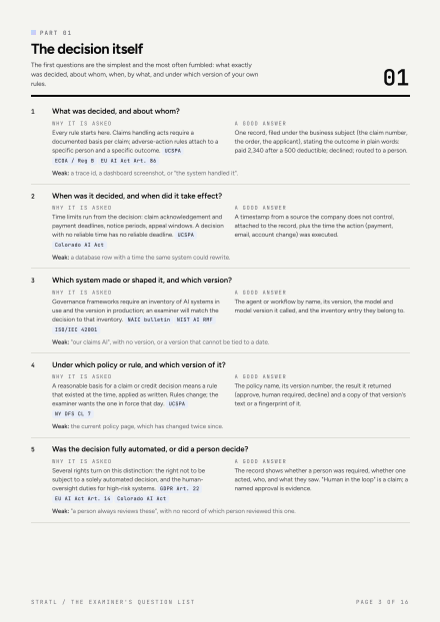
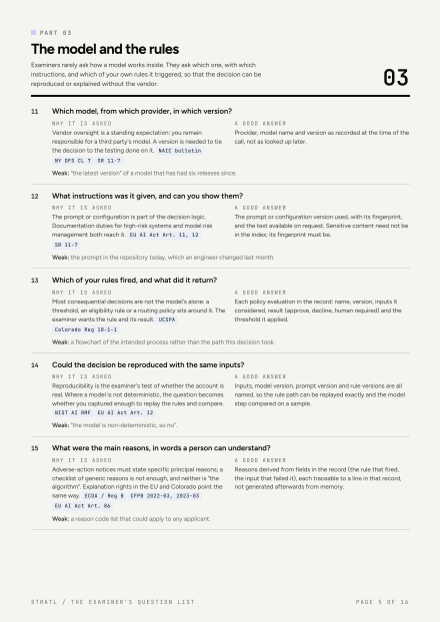
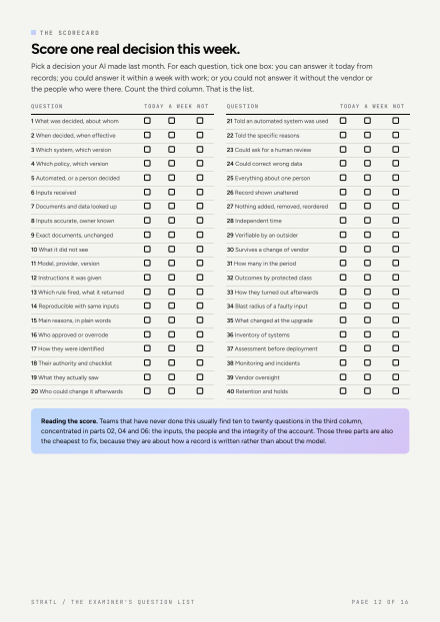
- 01
The decision itself
What was decided, about whom, when, by which system, under which policy.
- 02
What the system saw
Inputs, documents, retrieved data, and who supplied them.
- 03
The model and the rules
Which model and version, which prompt, which rule fired, which threshold.
- 04
The people
Who approved, how they were identified, what authority they had, what they saw.
- 05
The person affected
What they were told, when, and how they could ask for a human review.
- 06
Integrity of the account
Can you show the record is unchanged, and can someone else check it?
- 07
Patterns across decisions
How many like it, how they turned out, what else used the same model or prompt.
- 08
Governance
Inventory, testing before use, monitoring, incidents, vendors, retention.
The questions are predictable. The answers usually are not ready.
We build a system of record for AI decisions, so we spend our days with the people who have to answer these questions. The list is what they get asked. Most of it can be answered with tools you already have; the guide says how. The last two pages say where Stratl fits and, as plainly, what it does not do.
No question depends on Stratl. Where a product helps, the guide names the property to look for, not a brand.
Every rule is cited by its public name. The guide shows the date it was checked, because these frameworks move.
Written by engineers and operators, from the public texts and from practice. Confirm anything that matters with counsel.
Before you type your address.
What do you do with my email address?
We store it with the time of the request and send one email carrying the download link. If you tick the box to hear about Stratl, we may write occasionally, and every such email has a way to stop. If you do not tick it, that one email is all you get. The details are in the privacy page, clause nine.
Can I share the PDF with my team?
Yes. Forward it, print it, put it in your wiki. The only thing we ask is that you keep the title page, which says who wrote it and when.
Is this legal advice?
No. It is a practical guide written by the people building Stratl, from the public text of each rule and from what examiners ask in practice. The frameworks change; the guide shows the date it was checked. Confirm anything that matters with your counsel.
Does it push Stratl?
The last two pages say where Stratl fits and what it does not do. The thirty-eight before them are useful whether or not you ever talk to us, and most of the questions can be answered with the tools you already have.
See the record behind the questions.
Every question in this guide has a field in a Stratl decision record. Create a workspace, record a decision from the agent you already run, and verify it yourself in under an hour.